Vaccine preventable diseases
Children and Young People
Disease-Free Years
Excess Seasonal Mortality
Health Protection
Healthy Lives
Immunisation
Influenza
Maternal Health
Mortality
Newborn Health
Population Health
Protective Measures
Seasonal Immunisation
Tuberculosis
Vaccinations
Vaccine Preventable Diseases
 Introduction
Maintaining good health and a high quality of life is strongly supported by effective public health measures, particularly the prevention and control of infectious diseases. Advances in medical science, surveillance, and evidence-based interventions have significantly reduced illness, disability, and premature mortality. Among these interventions, vaccination is one of the most effective, providing individual protection, reducing health inequalities, and preventing community outbreaks.
Vaccine-preventable diseases are caused by viruses or bacteria that spread through direct contact, airborne transmission, contaminated surfaces or food, or through vectors such as mosquitoes. More than 30 infectious diseases worldwide are recognised as preventable through vaccination, including influenza, pertussis (whooping cough) and measles.
Since the establishment of the National Health Service (NHS) in 1948, the United Kingdom (UK) has implemented a national vaccination programme delivered across the life course. This programme continues to evolve in response to changing epidemiology and innovations in vaccine development, resulting in substantial reductions in serious infectious diseases and related deaths. In Derbyshire, strong vaccine uptake helps protect individuals, reduces avoidable GP consultations, prevents complications that require further treatment, and reduces pressure on hospital services. Vaccination also supports population health and resilience by limiting the spread of infection.
This summary provides an overview of vaccine-preventable diseases and outlines the role and importance of the UK immunisation programme, setting the context for understanding local needs and priorities in Derbyshire.
 Why is it important to Population Health?
Infectious diseases remain a major public health concern, with impacts that extend beyond individuals to families, communities, health services, and wider society. Without effective prevention and control measures, diseases can spread rapidly with a snowball effect, at times resulting in an ‘outbreak’. An outbreak is the sudden occurrence of cases of a disease within a specific community or setting (like a residential care home or school) at a higher rate than would normally be expected. The impact can be profound, with more illness, disability, significant disruption to daily life and more preventable deaths.
The UK’s national notification system for selected infectious diseases enables early detection and timely public health action. This helps limit transmission, identify sources of infection, and support affected populations. When control measures are insufficient, outbreaks can occur, placing substantial pressure on healthcare services and leading to shortages of staff, hospital beds, and essential medical supplies. These challenges can further affect workplaces, educational settings, and essential community services.
Modern public health practice seeks to reduce these risks through surveillance, early diagnosis, infection control measures, safe food and water systems, and vaccination. Together, these approaches help protect vulnerable populations, reduce transmission, and support the resilience and sustainability of health and care systems.
Vaccination remains one of the most effective tools for preventing infectious disease and its complications. High vaccine coverage helps prevent outbreaks, reduces severe illness, and protects individuals who cannot be vaccinated. By lowering the number of GP consultations, hospital admissions, and the need for antibiotic treatment, vaccination also supports the efficient use of NHS resources. The UK national vaccination programme has significantly reduced the burden of serious diseases, such as diphtheria and whooping cough. While now rare, these infections have not been eliminated and can re-emerge when vaccination coverage declines.
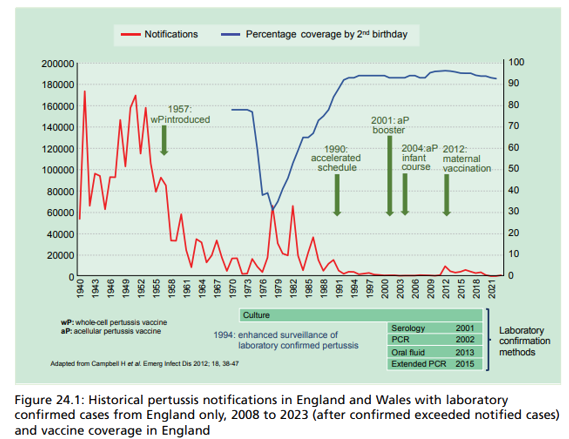
The graph below shows since its introduction in the 1940’s, the whooping cough vaccine and its delivery has been improved, to keep the number of cases and deaths low.1
Maintaining high uptake of recommended vaccines is essential for protecting population health, particularly for babies, older adults, and people with long-term conditions, as well as safeguarding the wider community. Effective prevention and control of infectious diseases remain central to improving population wellbeing, and immunisation continues to be a core priority within national and local public health strategies, including in Derbyshire.
 The Derbyshire Population Health Approach
The Derbyshire Population Health Approach focuses on prevention, population health, evidence-informed practices, causes, and collaboration. It emphasises proactive measures to prevent health issues, tailors interventions to specific populations, incorporates evidence-informed practices, addresses underlying causes, and promotes collaboration for effective action.
When considering vaccine preventable diseases within The Derbyshire Population Health Approach:
• Prevention
Vaccination is one of the most effective public health measures available to prevent infectious diseases, reduce illness and disability, and protect the wider population. Vaccines work by preparing the immune system to recognise and respond to harmful pathogens before they cause serious harm. Many severe diseases including measles, mumps, rubella, chickenpox, polio, diphtheria, tetanus, whooping cough, hepatitis B, influenza, HPV, and COVID-19 are now largely preventable through routine immunisation.
Vulnerable groups, including older people and those with existing health conditions, are often most severely affected by infectious diseases, which can widen existing health inequalities. Vaccination remains a vital means of protection, enabling individuals to develop immunity in a controlled and safe way. Once vaccinated, it typically takes around two weeks to achieve full immunity, making timely vaccination essential.
Herd immunity plays an important role in preventing disease transmission. When a sufficient proportion of the population is immune, infections cannot spread easily, thereby protecting individuals who cannot be vaccinated. Required immunity levels vary by disease; for example, the World Health Organisation (WHO) recommends 95% immunity to prevent measles outbreaks, while other diseases require lower coverage.
Preventing infectious diseases remains a core public health priority in Derbyshire. High vaccination uptake protects vulnerable individuals, reduces health inequalities, prevents outbreaks, and supports the sustainability of the local health and care system.
High vaccination coverage benefits Derbyshire by:
- Reducing the circulation of infectious diseases
- Protecting high-risk groups, including babies, older adults, and people with underlying conditions
- Helping prevent school and workplace disruption
- Reducing avoidable GP consultations, A&E attendances, and hospital admissions
- Decreasing antibiotic use associated with secondary infections
- Supporting long-term health system resilience

Vaccine preventable diseases affect population groups in Derbyshire unevenly, with outcomes strongly influenced by age, deprivation, long-term health conditions, and access to healthcare. People living in the most deprived areas experience higher rates of infectious disease and hospital admission. Contributing factors include overcrowded housing, lower income, lower educational attainment, and barriers to accessing timely vaccination and primary care.
Older adults and individuals with existing health conditions such as respiratory or cardiovascular disease are more vulnerable to severe illness during outbreaks. This increases demand on local NHS and social care services. Children and young people are also impacted differently. Infections can spread rapidly in nurseries and schools due to close contact and high mixing. While routine vaccination reduces serious illness, lower uptake in some communities heightens the risk of outbreaks and increases the likelihood of requiring medical intervention.
Babies under 12 months face the highest risk because of immature immune systems and the fact that some vaccines are not licensed for this age group. Their vulnerability highlights the need for parents, carers, and those working with infants to minimise their own risk of transmitting infections.
Inclusion health groups including people experiencing homelessness, asylum seekers, and individuals affected by substance misuse often experience greater exposure to infection and face barriers to vaccination and timely healthcare. These challenges contribute to poorer outcomes compared with the wider population.
Overall, vaccine preventable diseases in Derbyshire contributes to existing health inequalities. Public health strategies therefore prioritise prevention, improving vaccination uptake, and targeted support for vulnerable and under-served groups.
• Evidence
There is strong scientific evidence supporting the effectiveness of vaccines, drawn from laboratory research, clinical trials, and decades of real-world population data. Vaccination has led to dramatic reductions in serious infectious diseases, and in some cases, complete elimination. Smallpox has been eradicated globally, and diseases such as polio and diphtheria have declined by more than 99% in countries with high vaccination coverage.
Global studies estimate that vaccination has prevented approximately 154 million deaths since 1974, primarily among infants and young children.2 The WHO reports that vaccines prevent 3.5-5 million deaths every year worldwide.3
Advances in “platform technology” have also been critical. Platform technologies provide a foundational template for vaccine development, including established manufacturing and storage processes. This reduces development time and cost and enables rapid production of new vaccines, particularly during public health emergencies such as pandemics.
The Joint Committee on Vaccination and Immunisation (JCVI) is an expert scientific advisory committee that advises the UK government on vaccinations. They consider a vaccination programme to be cost effective if the health benefits are greater than the costs when each quality-adjusted life year (QALY) is valued at £20,000.
In the UK, the Medicines and Healthcare products Regulatory Agency (MHRA) ensures that all vaccines are safe, effective, and of high quality. Before a vaccine is authorised for use, it must undergo three phases of clinical trials. MHRA rigorously reviews the data before granting approval for manufacture and use. Once deployed, vaccines continue to be monitored through the Yellow Card Reporting System.
The Yellow Card system relies on voluntary reporting of suspected side effects by healthcare professionals and the public. Reported events are not necessarily caused by the vaccine but provide an early signal that may warrant further investigation. This system is an important component of ongoing safety monitoring and helps identify any issues not previously recognised.
• Causes
Vaccine preventable diseases continue to circulate due to a combination of social, behavioural, and system-level factors that reduce the impact of vaccination programmes. A key driver is low vaccination uptake, which weakens herd immunity and allows infections such as measles and whooping cough to spread more easily within communities.
Some individuals delay or decline vaccination because of misinformation, concerns about side effects, limited understanding of vaccine benefits, or reduced trust in health services. Inequalities and access barriers also contribute significantly. People living in deprivation, experiencing homelessness, or working in insecure or inflexible employment may face challenges such as transport difficulties, language barriers, or limited availability of appointments. Disruptions to routine health services such as those seen during the COVID-19 pandemic have also resulted in missed vaccinations, leaving some groups unprotected.
Population movement, including international travel and migration, can introduce diseases into areas with lower vaccine coverage, increasing the risk of outbreaks. Overcrowded living environments, schools, workplaces, and care settings can then facilitate rapid transmission. Additionally, declining public awareness of the seriousness of vaccine preventable diseases may reduce motivation to vaccinate, particularly among those who have never witnessed the consequences of conditions such as polio or diphtheria.
Together, these factors contribute to the ongoing spread of vaccine preventable diseases despite the availability of safe and effective vaccines. This underscores the importance of accessible vaccination services, clear and reliable public health communication, and strong system-wide approaches to prevention.
• Collaboration
Collaborative local working is essential for reducing vaccine preventable diseases, as no single organisation can achieve high vaccination coverage or manage outbreaks alone. Coordinated action across the NHS, local authority public health, education, social care, and community partners improves access, strengthens public confidence, and supports consistent communication.
Partnerships with voluntary and community organisations help address barriers faced by disadvantaged groups, enabling tailored outreach and reducing health inequalities. Effective surveillance and outbreak response also depend on collaboration between public health teams, laboratories, primary care, schools, and care settings to ensure timely reporting and swift implementation of control measures.
Overall, joint working enhances system resilience and supports equitable protection for the population.
 Latest Derbyshire Data
Trend Data
Prevalence Maps of Derbyshire
The maps below illustrate various geographies for Derbyshire. LSOAs and MSOAs are geographical divisions used for statistical purposes, allowing for more detailed analysis of local data. In these maps, you can explore various health indicators and data for Derbyshire, providing valuable insights into the area’s health and wellbeing.
 |
In the top right of the map, you’ll find the ‘Layer Control’ icon. This is an easy way to customise what you see on the map visualisation. Click the ‘Layer Control’ to choose which information is displayed on the map. Pick the indicator that interests you the most, and the map will transform accordingly. |
Slope Index
This chart illustrates the differences in health and lifestyle factors across areas in Derbyshire, from the most deprived (decile 1, red) to the least deprived (decile 10, green). As you move from left to right on the chart (from more deprived to less deprived areas), the line shows whether these factors are becoming more or less common. Essentially, it’s a way to see how living in wealthier or poorer areas affects the prevalence of these factors.
 Further Analysis & Assessments
Derbyshire Joint Strategic Needs Assessment (JSNA) involves a thorough examination of a specific health problem, exploring its causes, consequences, and underlying factors. It combines various data sources, collaboration with stakeholders, and rigorous analysis to generate insights for evidence-informed interventions and policy changes.
 More Information & Resources
Here is a list of useful resources and information with regard to bowel cancer. These materials are meant to provide individuals, healthcare professionals, and communities with the knowledge and tools they need as part of efforts to address bowel cancer as a population health topic.
Contributors
Charlotte Reece, Advanced Public Health Practitioner, Health Protection
Alfred Boakye-Amponsah, Advanced Public Health Practitioner, Health Protection